
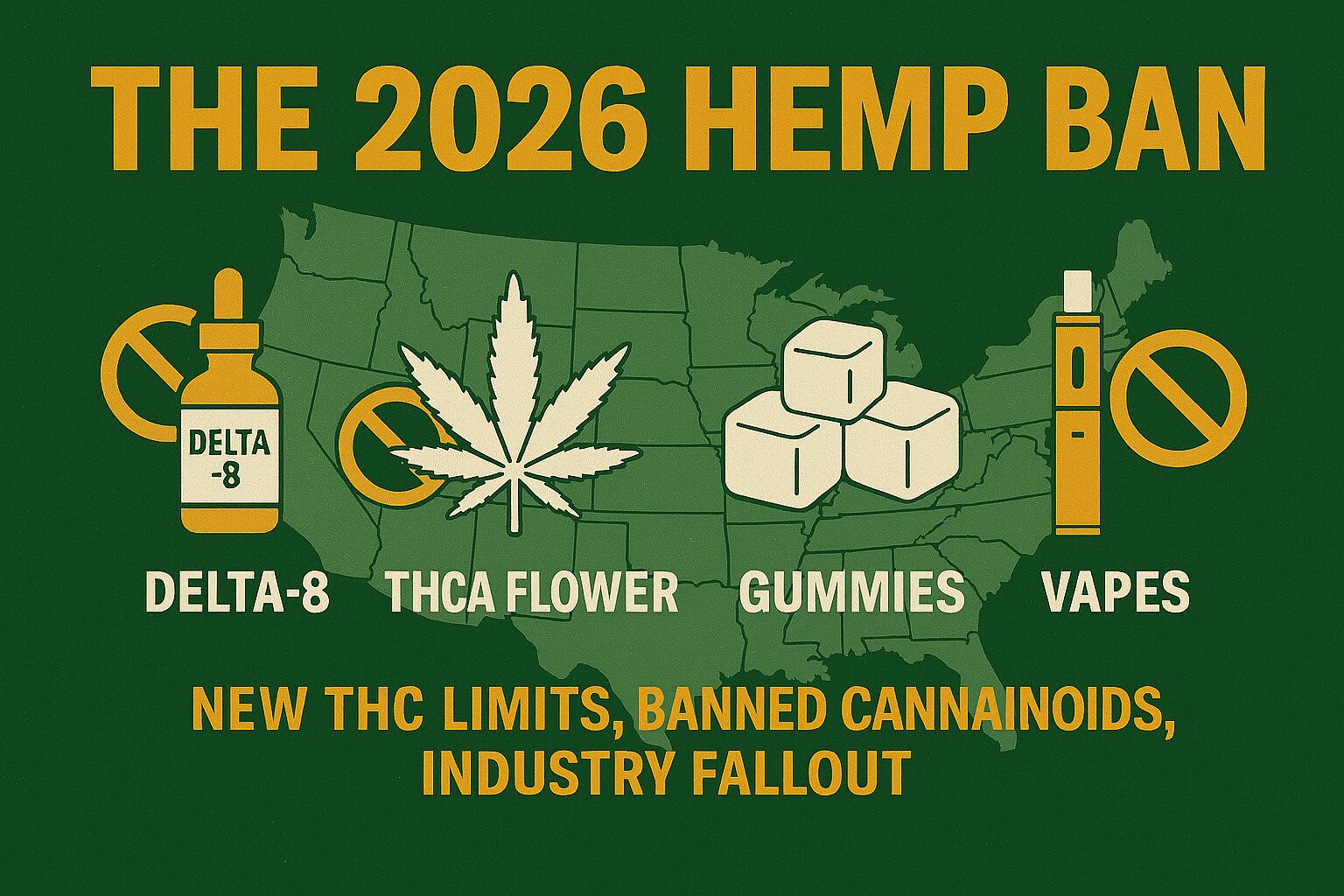
A quiet amendment with massive consequences for cannabis, commerce, and consumer access
What the Law Actually Says
On November 12, 2025, Congress passed the Continuing Appropriations Act (H.R. 5371), a must-pass funding bill that quietly included a sweeping amendment redefining hemp under federal law. The new rules take effect November 12, 2026, and will:
- Replace the delta‑9 THC test with a total THC standard measured after decarboxylation — including THCA, delta‑8, delta‑10, THCP, and other analogs Mondaq
- Ban all synthetically derived cannabinoids, including those created via isomerization from CBD (e.g., delta‑8, THC‑O, HHC) Mondaq
- Limit finished consumer products to 0.4 mg total THC per container, regardless of serving size or format Extract Labs
- Restrict intermediate hemp materials (distillates, isolates, crude extracts) to business‑to‑business sales only Mondaq
- Trigger enforcement under the Controlled Substances Act for non‑compliant products, effectively reclassifying them as illegal marijuana Mondaq
This is not a tweak. It’s a de facto ban on nearly every intoxicating hemp product currently sold in the U.S.

What Products Are Affected
| Product Type | Status After Nov 2026 |
|---|---|
| Delta‑8, Delta‑10, THC‑O | Banned (synthetic conversion) |
| THCA flower | Banned (exceeds total THC threshold) |
| Full-spectrum CBD gummies | Likely banned (exceeds 0.4 mg THC limit) |
| Hemp vapes and tinctures | Banned (THC content + synthetic origin) |
| Industrial hemp (fiber, seed) | Unaffected |
| CBD isolate (non-intoxicating) | Likely allowed if THC-free |
Even products with trace THC — like full-spectrum CBD — may be banned if they exceed the 0.4 mg per container threshold. Most current edibles contain 20–50 mg per serving, making them 100x over the limit Extract Labs.

How Businesses Are Responding
The hemp industry is entering a year-long scramble to survive. Key responses include:
1. Legal Challenges
- Multiple trade groups are preparing lawsuits arguing that Congress exceeded its authority by retroactively banning products legalized under the 2018 Farm Bill.
- Legal teams are exploring constitutional challenges based on commerce clause, due process, and regulatory overreach Mondaq.
2. Reformulation & Rebranding
- Some companies are pivoting to CBD isolate, non-intoxicating terpenes, or low-dose formulations that comply with the 0.4 mg rule.
- Others are exploring state-licensed marijuana channels to continue selling higher-THC products legally.
3. State-Level Workarounds
- In Alabama, new laws now restrict hemp sales to licensed, in-person retailers with strict packaging and testing rules themarijuanaherald.com.
- California banned hemp extracts in food/supplements unless ultra-refined and THC-free.
- Kentucky now regulates THC beverages like alcohol, capping them at 5 mg per container.
- These laws may serve as templates for post-ban survival — or as preemptive compliance with federal enforcement.
4. Industry Consolidation
- Smaller brands reliant on intoxicating hemp SKUs face extinction.
- Larger operators with diversified portfolios and legal teams are positioning to absorb market share.

Federal & State-Level Movement
Federal Pushback
- A bipartisan group of 39 state Attorneys General urged Congress to close the “Farm Bill loophole,” citing child-targeted marketing and lack of regulation manzurilaw.com.
- However, Senator Rand Paul (R-KY) and others opposed the ban, arguing it harms farmers and small businesses.
- The FDA is expected to issue guidance by February 10, 2026, clarifying which cannabinoids are permitted and how “container” is defined Mondaq.
State Resistance & Adaptation
- North Carolina, a top hemp producer, is exploring state-level protections and advisory councils to preserve parts of the industry WFAE 90.7.
- Washington State and Michigan are tightening cannabis rules, but have not yet addressed hemp directly.
- Oklahoma and California are integrating hemp into broader cannabis frameworks, potentially offering safe harbor for compliant operators.
Economic Fallout
- The intoxicating hemp sector supports an estimated 300,000 U.S. jobs manzurilaw.com.
- Thousands of SKUs — from gummies to beverages — will become federally illegal.
- Contracts, leases, and insurance policies with federal compliance clauses may be voided.
- Banking and payment processors may terminate accounts tied to banned products Scarinci Hollenbeck.
This isn’t just a regulatory shift. It’s a market collapse in slow motion.
What Comes Next
The hemp industry has until November 12, 2026 to adapt, litigate, or lobby for change. Key developments to watch:
- FDA guidance in early 2026
- Litigation outcomes from industry lawsuits
- Congressional amendments to soften or revise the ban
- State-level protections or licensing frameworks
- Consumer education around what remains legal

Closing Reflection
The 2026 hemp ban is a turning point. It doesn’t just close a loophole — it redefines the boundaries of cannabis commerce. For businesses, it’s a countdown. For regulators, it’s a reset. And for consumers, it’s a moment of confusion, clarity, and choice.
420.school will continue tracking the fallout — from courtroom to farm field, from gummy to statute.
