
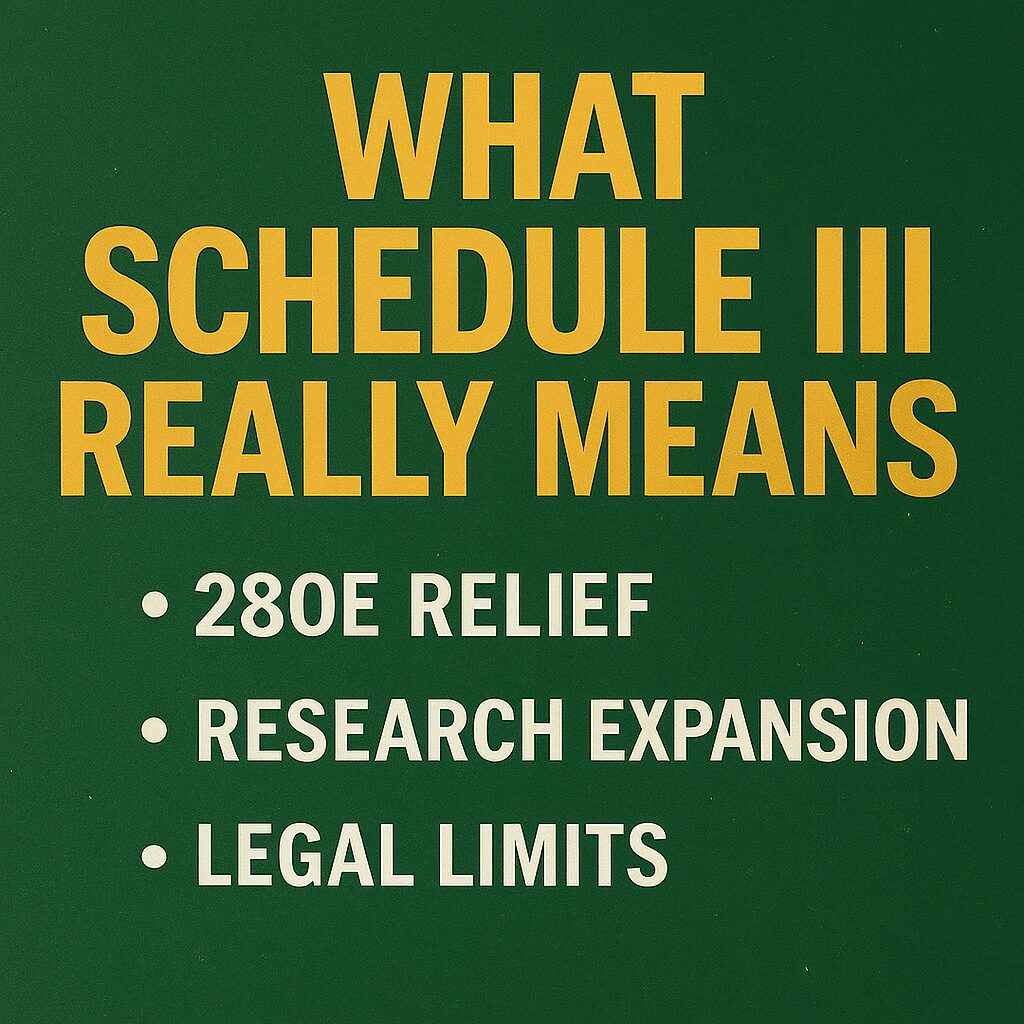
280E, research access, and the limits of “legalization”
What “Schedule III” actually is
Under the Controlled Substances Act, drugs are divided into five schedules based on two criteria:
- Potential for abuse
- Currently accepted medical use
Schedule I is the harshest category: high abuse potential, no accepted medical use, and severe restrictions. That’s where federal law has kept “marihuana” since 1970. Schedule III is different: it’s for substances with accepted medical use and moderate to low risk of dependence (think certain steroids, ketamine, buprenorphine). Vicente LLP
Moving cannabis from Schedule I to Schedule III would not be a symbolic tweak. It would be the first time the federal government formally admits that cannabis has medical value and does not belong in the same legal bucket as heroin.
On December 18, 2025, President Trump signed an executive order directing the Department of Justice and DEA to expedite the process of moving cannabis to Schedule III, leaning on HHS’s 2023 recommendation and a stalled DEA rulemaking process. AAFCPAs Vicente LLP
That order doesn’t finish the job—DEA still has to finalize a rule—but it frames where 2026 is headed.
The 280E problem: why Schedule III is a tax earthquake
What 280E does now
Internal Revenue Code Section 280E is one of the most brutal sentences in cannabis law. It says that any business “trafficking in” Schedule I or II substances cannot deduct ordinary business expenses—things like rent, payroll, marketing, and most operating costs.
For state‑legal cannabis companies, that means:
- Dispensaries and cultivators are taxed on something close to gross income, not real profit
- Effective federal tax rates can soar above those faced by comparable non‑cannabis businesses
- Many otherwise viable companies operate on razor‑thin margins or outright losses once taxes are factored in
280E is the quiet policy that has shaped who survives in legal markets.

What happens to 280E at Schedule III
Section 280E applies only to businesses dealing in Schedule I or II substances. If marijuana moves to Schedule III, state‑legal cannabis operators would no longer fall under 280E at all. AAFCPAs Vicente LLP
That means:
- Normal business deductions return
Rent, wages, advertising, insurance, and many other expenses become deductible again. - Effective tax rates drop sharply
Companies’ after‑tax cash flow improves, sometimes dramatically, depending on how heavily 280E was hitting them. - Industry consolidation accelerates
Operators who have survived under 280E’s pressure suddenly gain room to expand, acquire distressed assets, or reinvest.
As one tax analysis put it, rescheduling that removes cannabis from 280E’s reach is a “major turning point” for state‑legal operators and a central reason rescheduling matters at all. AAFCPAs
What Schedule III does not do is refund the past. Unless Congress passes explicit relief, rescheduling will mostly affect future tax years. The historical 280E pain remains baked into the ledgers.
Research rules: from blockade to bottleneck
Life under Schedule I
Schedule I has never just been a label; it has been an obstacle course.
To research cannabis under Schedule I, scientists face:
- Multiple layers of DEA registration and security requirements
- Strict sourcing rules, historically tied to a limited number of federally sanctioned suppliers
- Heavy administrative burdens that deter many institutions from even trying
This has produced a strange reality: millions of Americans use cannabis under state law, but high‑quality, large‑scale clinical data lags behind practice because studying the plant has been so hard.
What Schedule III unlocks
Rescheduling to Schedule III would not suddenly make cannabis research easy—but it would remove some of the most unreasonable barriers. Analysts expect: AAFCPAs Vicente LLP
- Simpler access to research material
Institutions could obtain cannabis products under less restrictive rules than Schedule I demands, and supply chains could better match what patients actually use. - Expanded eligibility for grants and trials
Once cannabis is recognized as having accepted medical use, it becomes easier for federal agencies and major health systems to justify funding studies. - More diverse study designs
Researchers can move beyond narrow, small‑sample projects and design larger, longitudinal studies on efficacy, safety, dosing, and public health impacts.
In other words, Schedule III doesn’t hand the answers to us. It finally allows us to ask the real questions at scale.

The new gatekeepers
There is a trade‑off. As cannabis becomes a Schedule III substance:
- Pharmaceutical companies and big research institutions gain a clearer regulatory pathway to develop cannabis‑based or cannabinoid‑based medicines.
- Intellectual property (patents, proprietary formulations, branded pharmaceuticals) may increasingly define parts of the medical cannabis landscape.
That raises critical questions: Who controls the data? Who benefits from the IP? And how much space remains for community‑based, non‑pharmaceutical medical use in a world where cannabis is treated more like a “proper” drug?
What Schedule III does not do
A crucial part of explaining Schedule III is correcting the common misconception that “rescheduling = legalization.” It doesn’t.
Even at Schedule III, cannabis would still be illegal under the CSA except in tightly controlled medical contexts. State adult‑use markets would continue to exist in a legal gray zone where federal enforcement is restrained by policy, not erased by statute. Vicente LLP themarijuanaherald.com
Here’s what rescheduling does not automatically change:
- Adult‑use legality
Recreational cannabis remains illegal under federal law. State programs survive through political tolerance, not formal legalization. - Interstate commerce
Shipping state‑legal cannabis across state lines stays a federal offense unless Congress creates an explicit framework. - Immigration, housing, and employment rules
Non‑citizens can still face immigration consequences for cannabis; employers and landlords can still adopt zero‑tolerance policies unless other laws intervene. - Past convictions and records
Rescheduling does not, on its own, vacate prior cannabis convictions, release people from prison, or create expungement rights. Those require separate legislative or executive action.
Schedule III is best understood as reframing and relieving—not as “mission accomplished.”

Political and cultural consequences
Narrative shift and political cover
Moving cannabis to Schedule III signals something simple but powerful: the government is willing to say, in law, that the old classification was wrong. themarijuanaherald.com
That has ripple effects:
- Public opinion
Many voters treat federal scheduling as a proxy for risk. A move to Schedule III undercuts decades of “no medical use” messaging and may soften resistance to broader reforms. - Lawmakers’ incentives
Some politicians who were hesitant to back legalization can now point to Schedule III as evidence that reform is mainstream, not fringe. It gives them political cover to support banking reform, expungement bills, or even full federal legalization later.
In short, rescheduling shifts the Overton window of what feels acceptable to propose and pass.

Industry structure and equity
By lifting 280E, Schedule III is likely to:
- Strengthen the position of already‑established, well‑capitalized operators
- Make it easier for larger financial institutions to lend to cannabis businesses by lowering perceived federal risk Vicente LLP
But without deliberate equity policy, that can widen existing gaps:
- Social equity licensees and small, under‑capitalized operators may not automatically benefit from improved tax treatment if they’re already struggling with access to capital, real estate, and regulatory costs.
- Communities most harmed by prohibition do not see repair just because the tax code softens and research rules ease.
Schedule III, left on its own, is economically corrective but not morally reparative.

The bottom line for 2026 and beyond
If DEA finalizes a rule moving marijuana to Schedule III in 2026—and that rule survives inevitable legal challenges—three big things change:
- Cannabis businesses escape 280E
Federal tax burdens fall, cash flow improves, and consolidation pressures grow. AAFCPAs Vicente LLP - Research accelerates and professionalizes
Universities, hospitals, and pharmaceutical companies gain clearer pathways to study and develop cannabis‑based medicines, even as questions linger about who controls the resulting knowledge. - The narrative cracks, but prohibition persists
The government admits cannabis has medical use, yet full federal legalization remains out of reach without an act of Congress.
Schedule III is not the end of the story. It’s the moment the federal script changes from “no medical use” to “we were wrong—but we’re still in charge.”
