
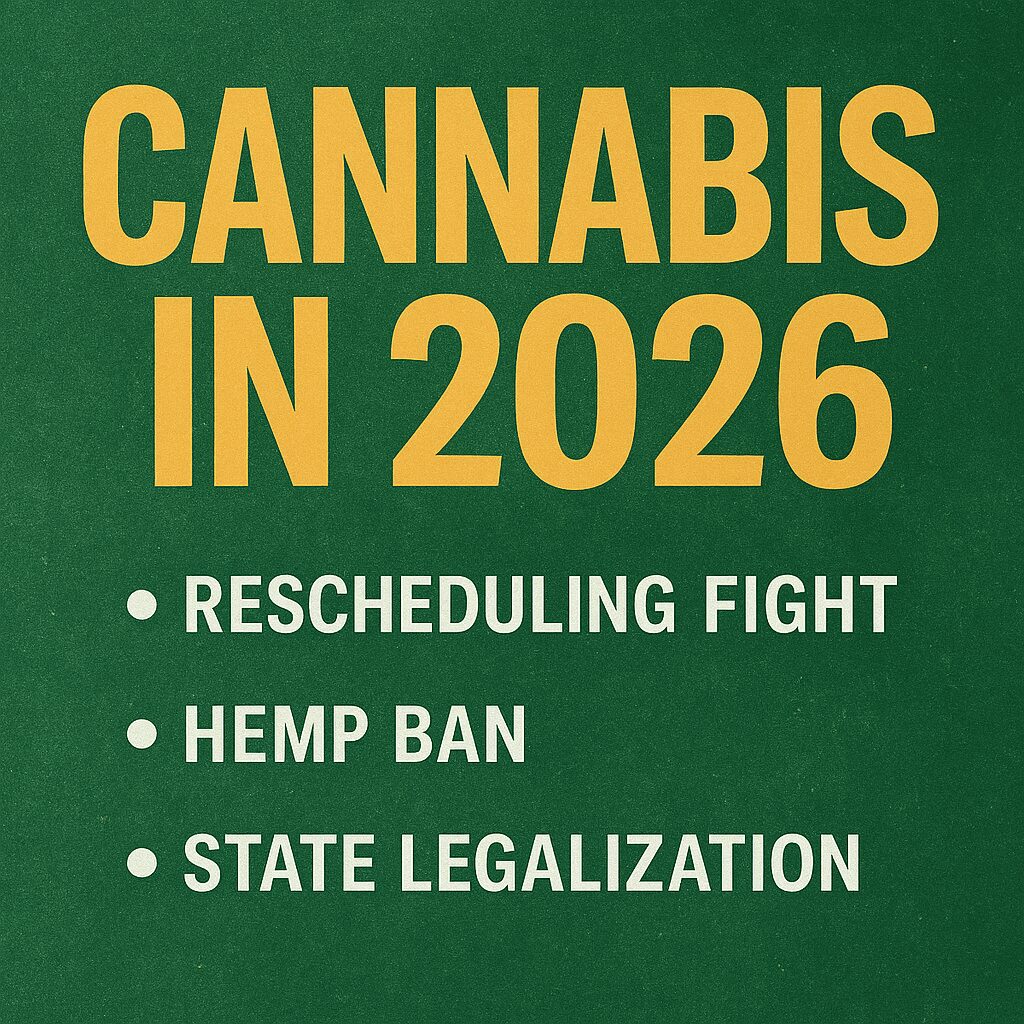
From Trump’s rescheduling order to hemp bans and ballot fights, the next year will redraw the map for weed in America.
The federal pivot: Trump’s rescheduling order and what it actually does
On December 18, 2025, President Donald Trump signed an executive order directing the Attorney General to “complete the process” of moving marijuana from Schedule I to Schedule III of the Controlled Substances Act “on an expedited basis.” Debevoise & Plimpton LLP
This was not legalization. It was a political shove applied to a process that had been grinding slowly forward since 2023, when HHS formally recommended rescheduling and DEA initiated notice‑and‑comment rulemaking in 2024. That rulemaking drew a record 43,000 public comments and then largely stalled—until Trump’s order told DOJ and DEA to pick up the file and finish. National Law Review OPB

What rescheduling to Schedule III would mean
If DEA does finalize a rule in 2026, rescheduling to Schedule III would:
- Recognize medical value
Cannabis would no longer sit in the legally absurd category reserved for drugs with “no accepted medical use.” - Unlock major tax relief
Section 280E of the tax code, which prevents businesses trafficking in Schedule I or II substances from deducting normal expenses, would no longer apply to state‑legal cannabis companies. That’s an immediate, massive financial shift for operators. Debevoise & Plimpton LLP - Ease some research barriers
Researchers could work with cannabis under less onerous rules than Schedule I imposes, potentially accelerating clinical trials and data quality.
But rescheduling would not:
- Legalize cannabis nationally
- Allow interstate commerce in state‑legal marijuana
- Automatically change federal employment, drug testing, or immigration rules
Trump’s order cannot, by itself, rewrite the CSA. DEA still has to complete rulemaking consistent with administrative law, and any final rule will almost certainly face litigation from multiple directions. OPB
2026, in other words, is likely to be the year of the fight over rescheduling, not the year everything becomes simple.
The hemp time bomb: a federal ban arrives in November 2026
While most of the industry’s attention is on rescheduling, Congress quietly planted a different explosive: a near‑total ban on psychoactive hemp products, effective November 12, 2026. Debevoise & Plimpton LLP
In the government funding bill that ended a shutdown in late 2025, lawmakers reversed the 2018 Farm Bill’s permissive hemp language by:

- Treating many hemp products with even small amounts of THC as “marijuana” under federal law
- Effectively targeting the booming market in delta‑8, delta‑10, “THCA flower,” and many full‑spectrum CBD products
The same Trump order that pushed rescheduling also acknowledged this looming cliff for the CBD industry and promised to “work with Congress” to preserve access to certain full‑spectrum products. But as written, the hemp ban will hit in late 2026 unless Congress revises or replaces it. Debevoise & Plimpton LLP National Law Review
The paradox for 2026:
- Marijuana may move down the schedules
- Hemp products may be shoved up into stricter control
That inversion will reshape who survives: well‑capitalized state‑licensed cannabis operators could gain ground as gray‑market hemp brands get squeezed out, even while both sectors struggle to interpret overlapping rules.
State‑level horizon: 2026 as a ballot and legislative inflection year
Unlike 2024, 2025 was relatively quiet on state legalization. Analysts now expect 2026 to be the year the map moves again, both forward and backward. The Hill
States most likely to legalize or expand in 2026
Policy watchers and cannabis advocates currently flag at least eight states as serious candidates for major change by the November 2026 election. themarijuanaherald.com The Hill
Florida – the big constitutional swing
- A new adult‑use constitutional amendment campaign has already surpassed one million signatures, positioning it well for the 2026 ballot after falling short of the 60% threshold in 2024. themarijuanaherald.com The Hill
- Trump himself publicly supported the prior legalization amendment as a Florida voter in 2024, signaling that Republican opposition to adult‑use is not monolithic. The Hill
If Florida flips, it doesn’t just add another legal state. It shifts the narrative about cannabis in Republican‑leaning states and in older, more conservative electorates.

Pennsylvania – legalization by legislature, not ballot
- Multiple bipartisan bills are in play to legalize adult‑use through statute rather than initiative.
- Governor Josh Shapiro has framed legalization as both criminal‑justice reform and a budgetary tool, emphasizing lost revenue to neighboring legal states. themarijuanaherald.com
If Pennsylvania moves in 2026, it will reinforce a core trend: Mid‑Atlantic and Rust Belt states using legalization as economic alignment and regional arms race.
New Hampshire – the last holdout in New England
- Lawmakers are expected to revisit adult‑use after repeated failures; several 2026 proposals are already pre‑filed, including a possible constitutional amendment to put the question directly to voters. themarijuanaherald.com Ballotpedia News
If New Hampshire legalizes, New England becomes a fully legal region, sharpening pressure on neighboring prohibitionist states elsewhere.
Nebraska & Missouri – the Midwest experiments
- Nebraska: An initiative would legalize recreational use for adults 21+, building on long‑running reform efforts. Ballotpedia News themarijuanaherald.com
- Missouri: A proposed “Marijuana Regulations Amendment” aims to expand rights to use, possess, and cultivate, and to recalibrate the current framework. Ballotpedia News
Together, these efforts test how far Midwestern voters are willing to go beyond early medical and limited adult‑use regimes.

Idaho – ballot access itself is on the line
Idaho may be the purest example of backlash:
- One certified 2026 ballot measure would ban citizen initiatives from legalizing marijuana or other psychoactive substances, reserving that authority solely for the legislature.
- Two competing initiatives would:
- legalize medical marijuana
- decriminalize adult‑use cannabis for people 21+ Ballotpedia News
2026 in Idaho is not just about cannabis. It’s about whether voters can ever use direct democracy to liberalize drug policy at all.
Backlash and revision: repeal, restriction, and tax cuts
Not every 2026 measure points toward expansion.
- Massachusetts: An initiative could appear on the ballot to repeal laws permitting adult‑use cannabis, a dramatic reversal in one of the earliest East Coast legal states. Ballotpedia News
- Washington: A proposed 2026 measure would slash the state’s cannabis excise tax from 37% to 7%, testing how much high tax burdens are driving consumers back to the illicit market. Ballotpedia News themarijuanaherald.com
The larger pattern: legalization is no longer binary. States are now iterating—tightening, loosening, and recalibrating—using ballot measures as tuning knobs for a maturing industry.
Market and cultural impacts of 2026’s likely shifts
Taken together—Trump’s rescheduling order, the hemp ban, and the 2026 state landscape—several deep impacts emerge.
Industry consolidation and the 280E effect
If rescheduling to Schedule III is finalized:
- Legacy cannabis businesses suddenly regain access to deductions for rent, payroll, marketing, and more.
- Margins improve for compliant, licensed operators at precisely the moment unregulated hemp‑derived THC businesses face a federal clampdown. National Law Review Debevoise & Plimpton LLP
The likely result is consolidation:
- Well‑funded, multi‑state operators and regionally dominant brands are better positioned to survive the transition from 280E and to navigate complex post‑hemp rules.
- Small hemp brands and under‑capitalized licensed operators may get squeezed—by both federal policy and state‑level competition.
In other words, 2026 may deepen the divide between cannabis as community‑scale craft and cannabis as heavily regulated, capital‑intensive enterprise.

Research, medicine, and the shape of “legitimacy”
Rescheduling, if completed, would:
- Make it easier for universities and hospitals to run clinical trials with cannabis formulations
- Encourage pharmaceutical companies and large healthcare systems to enter the space under more traditional medical frameworks OPB
But legitimacy cuts both ways:
- As cannabis is folded into medical and pharmaceutical systems, questions arise about who controls data, who profits from medical IP, and how much room remains for traditional or community‑based use.
- The standardization that research demands may clash with the diversity of cultivars, preparations, and cultural practices that define cannabis history.
2026 is therefore likely to sharpen a long‑running tension: cannabis as folk medicine and culture vs. cannabis as regulated biopharmaceutical ingredient.

Criminal justice and enforcement gaps
None of the likely 2026 shifts—rescheduling, hemp bans, or new state markets—automatically fixes the uneven legacy of enforcement.
- Federal rescheduling would not erase prior convictions or guarantee resentencing.
- State reforms remain patchy: some tie legalization to expungement and equity licensing; others barely mention repair. The Hill
What 2026 may bring instead is more visible contrast:
- In some states, people will open licensed stores selling products that look chemically similar to those for which others, often in different ZIP codes or demographics, still carry records.
- Hemp‑derived products criminalized at the federal level may remain widely available online or via informal channels, blurring the line between legal and illegal in practice.
The policy horizon, in other words, includes not just new markets, but new contradictions.

Cultural and political narratives: how 2026 reframes the plant
Beyond statutes and schedules, 2026 will shape the story the U.S. tells itself about cannabis.
Cannabis as “normal,” and why that matters
With each new state that legalizes—especially large, politically pivotal ones like Florida or Pennsylvania—the idea of cannabis as a normal consumer product solidifies. That brings:
- More mainstream branding and advertising
- More crossover with alcohol, wellness, and hospitality industries
- More pressure on federal actors to standardize rules around banking, interstate commerce, and safety themarijuanaherald.com The Hill
The risk is that normalization can flatten history: the plant appears as just another SKU, divorced from the communities that bore the brunt of prohibition.
Cannabis as a stress test for democracy
Idaho’s attempt to block voters from ever legalizing cannabis via initiative, Massachusetts’ flirtation with repeal, and tax‑cut or restriction measures elsewhere highlight something bigger: cannabis has become a proxy for how much power voters should have over controlled substances policy. Ballotpedia News
2026 will therefore test:
- The durability of direct democracy in drug policy
- The ability of organized opposition to reverse or freeze legalization
- The willingness of courts to referee these fights
In that sense, cannabis in 2026 isn’t just about weed; it’s about who gets to decide the rules of the game.
What to watch as 2026 unfolds
For anyone tracking cannabis seriously—policy professionals, advocates, patients, operators—several signals will matter more than the daily noise:
- DEA timelines and litigation
How quickly DOJ and DEA move on Trump’s rescheduling directive, and which lawsuits emerge to challenge or shape the final rule. National Law Review OPB - Congressional follow‑through on hemp
Whether lawmakers soften or refine the 2026 hemp product ban to preserve some forms of full‑spectrum CBD while eliminating the most controversial intoxicating products. Debevoise & Plimpton LLP - Key state outcomes
Florida’s ballot result; Pennsylvania’s legislative negotiations; New Hampshire’s latest attempt; and high‑signal measures in Idaho, Massachusetts, Missouri, Nebraska, and Washington. themarijuanaherald.com Ballotpedia News - Equity and repair benchmarks
Whether new legalization frameworks in 2026 embed meaningful expungement, community reinvestment, and equity licensing—or treat those as expendable.

Perspective
2025 ended with two contradictory moves: a presidential order to loosen marijuana’s status and a congressional law to tighten hemp’s. 2026 will determine whether those threads converge into a coherent framework or tangle into a deeper regulatory mess.
Either way, this year won’t be background noise.