
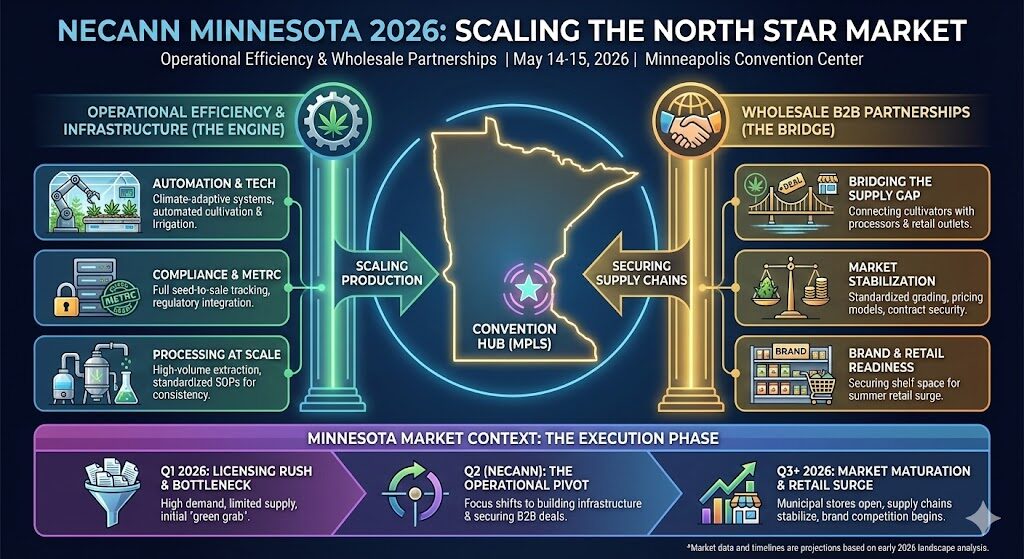
MINNEAPOLIS — While early-year events focused on the frantic “land grab” of licensing, the NECANN Minnesota Cannabis Convention (May 14-15, 2026) marks a fundamental pivot in the state’s industry lifecycle. Moving beyond the “how-to-apply” stage, the inaugural Midwest expansion of the New England Cannabis Convention arrives at the Minneapolis Convention Center to address a maturing market’s most pressing challenge: the wholesale supply gap.
As of early 2026, Minnesota remains a “high-margin, low-inventory” environment. With only a handful of large-scale cultivators currently online and wholesale prices stubbornly holding near $4,000 per pound, the May convention is where the industry’s mid-tier “Mezzobusinesses” and large-scale MSOs will lock in the partnerships required to keep retail shelves stocked through the summer.
The Infrastructure Engine: Efficiency at Scale
With 120+ exhibitors and over 60 expert speakers, the May convention is less of a classroom and more of a laboratory for operational efficiency. For cultivators navigating Minnesota’s unique climate-specific challenges, the focus has shifted from basic grow-ops to high-output automation.
Key technical tracks at the convention include:
- Climate-Adaptive Extraction: Maximizing terpene retention during high-volume processing in Northern climates.
- The METRC Standard: Transitioning from manual inventory to full seed-to-sale automation ahead of the summer retail surge.
- Wholesale Optimization: Establishing standardized grading and pricing models to stabilize the current volatile market.
The B2B Marketplace: Bridging the Supply Gap
NECANN has built its reputation on being the “annual meeting” for established operators. In Minneapolis, this means facilitating the B2B2C transition. For the 5,000+ professionals in attendance, the convention floor serves as a physical clearinghouse for wholesale agreements.
“If Lucky Leaf was about the ‘Green Rush,’ NECANN is about the ‘Green Grind.’ It’s where the infrastructure for 2027 is being bought and sold today.”
The 2026 Minnesota Landscape
By mid-2026, the Minnesota cannabis market has moved into a critical “execution phase.” The initial novelty of legal sales has been replaced by the hard reality of a supply-demand imbalance. With adult-use sales already surpassing medical revenue, the pressure on the state’s limited number of authorized wholesalers is immense. The May convention serves as a pressure valve, allowing newly licensed cultivators—particularly those in the 15,000 to 30,000 square-foot range—to find the processing and retail partners needed to move their first major harvests to market.
The regulatory environment is also tightening. With the March 31 hemp-transition deadline in the rearview mirror, the Office of Cannabis Management (OCM) has shifted its focus to rigorous enforcement of Chapter 342 standards. This has created a secondary market for compliance technology and laboratory services. Operators are no longer just looking for “a way in”; they are looking for “a way up,” investing heavily in automated irrigation, climate control, and enterprise resource planning (ERP) systems to protect their margins against future price stabilization.

Looking toward the latter half of the year, the “Minnesota Model” is being tested. As the state’s unique decoupled supply chain matures, the focus is shifting toward brand longevity and wholesale reliability. The partnerships formed this May will dictate which brands dominate the first government-run municipal stores launching this summer. In short, 2026 is the year the North Star state stops wondering if it can build a market and starts proving it can run one at scale.
